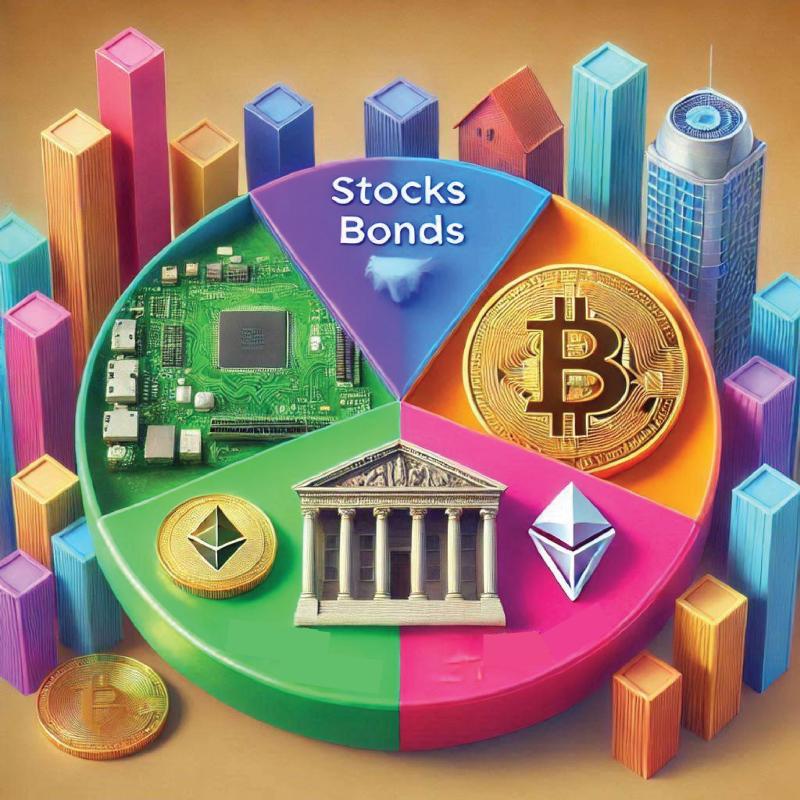
Summary: Digital assets are entering a new phase defined by institutional discipline, regulatory clarity, and strategic allocation. Investors are learning that diversification has replaced speculation as the primary motivation for investment. Tokenization is moving real-world assets on-chain, though liquidity remains thin. Stablecoins are reshaping cross-border payments, while regulatory frameworks like the CLARITY Act provide the foundation for continued institutional adoption.
From Speculation to Strategic Allocation
Fifteen years ago, crypto was an experiment: just one asset with a market capitalization of about $1 million. Today, it is an emerging industry consisting of millions of tokens with a combined market capitalization of roughly $3 trillion . The question is no longer whether digital assets matter—it’s how they are being integrated into modern portfolios.
The most significant shift investors are learning is the move from speculation to strategic allocation. According to Sygnum’s Future Finance 2025 report, portfolio diversification (57%) has overtaken short-term return potential (53%) as the primary reason to invest in digital assets for the first time . Institutional investors are no longer debating whether digital assets belong in portfolios but how to access them in a controlled, risk-managed way .
This evolution reflects a fundamental maturation of the asset class. As Anatoly Crachilov, CEO of Nickel Digital, notes, digital assets are moving into a “mature institutional phase” where growth will be driven less by speculative inflows and more by disciplined strategic allocations .
Regulatory Clarity: The Foundation for Growth
For nearly a decade, digital asset regulation in the United States was governed less by statute than by lawsuit—a system practitioners described as “regulation by enforcement” . That dynamic has fundamentally shifted.
The CLARITY Act
The Digital Asset Market Clarity Act of 2025 represents the most ambitious congressional response to regulatory uncertainty . The bill passed the Senate Banking Committee in May 2026 and has been placed on the Senate calendar for consideration . At its core, the CLARITY Act classifies digital assets into three categories:
- Digital commodities: Assets intrinsically linked to a blockchain whose value derives from the network’s use, falling under CFTC exclusive jurisdiction
- Investment contract assets: Tokens sold with the expectation of profit derived from the efforts of others, remaining under SEC oversight during their initial offering phase
- Permitted payment stablecoins: Governed by the GENIUS Act, signed into law in July 2025
SEC-CFTC Joint Interpretive Release
On March 17, 2026, the SEC and CFTC jointly issued an interpretive release establishing a five-category token taxonomy: digital commodities, digital collectibles, digital tools, stablecoins, and digital securities . The release confirms that Bitcoin, Ether, Solana, Dogecoin, and XRP are digital commodities, shifting primary oversight of those assets from the SEC to the CFTC .
The release also clarifies that classification is a moment-in-time question rather than a static label—a token’s classification can shift across its lifecycle as managerial efforts attach or fall away . This lifecycle framework has significant implications for both litigation and tax treatment.
The clearer demarcation should reduce the parallel SEC and CFTC investigations that have characterized recent enforcement, with a single agency now likely to take the lead in any given matter .
Tax Implications
The CLARITY Act’s allocation of CFTC jurisdiction over digital commodities could have significant tax implications. As Skadden’s analysis notes, if digital commodities are treated as commodities for tax purposes, non-U.S. persons may qualify for the Section 864(b)(2)(B) trading safe harbor, and traders may be eligible for Section 475 mark-to-market treatment . However, the PARITY Act, introduced in the House on May 19, 2026, would address these issues more directly .

Institutional Adoption: The Mature Phase
Digital assets are moving into a “mature institutional phase” according to Nickel Digital’s research, which surveyed institutions managing over $14 trillion in assets :
- 91% will increase digital asset holdings in the year ahead
- 65% rank digital assets among their top five asset classes for risk-adjusted returns over the next five years—higher than private equity (61%) and European equities (53%)
Pension funds and wealth managers are among the investor types likely to lead adoption over the next two years, with 69% of professional investors expecting pension fund investment to increase dramatically .
The Portfolio Allocation Question
According to the State Street Digital Assets and Emerging Technology Study, the average portfolio allocation across digital assets currently stands at 7%, with target allocations expected to rise to 16% within three years . Most common forms are digital cash and tokenized versions of listed equities or fixed income.
The shift in investment rationale is equally telling. According to Grayscale, since the Bitcoin ETPs launched in the U.S. in January 2024, global crypto ETPs have seen net inflows of $87 billion . Despite this success, Grayscale estimates that less than 0.5% of U.S. advised wealth is allocated to the crypto asset class—suggesting significant room for growth as more platforms complete due diligence and incorporate crypto into model portfolios .
Indexing and Institutional Infrastructure
The Index Industry Association notes that digital asset indexes are no longer peripheral tools—they are increasingly embedded in institutional workflows spanning portfolio construction, performance evaluation, trading, valuation, and regulatory reporting . As institutional investors move into digital assets, they expect the same caliber of indexing tools they rely on in public markets: transparent, rigorous, and built to measure these markets accurately .
Tokenization: Real-World Assets Move On-Chain
The tokenization of real-world assets continues to grow, though the market remains concentrated and liquidity is thin.
What’s Actually Tradable Today
According to research tracking roughly $60 billion in tokenized assets across more than 7,000 products :
- Tokenized Treasuries make up the largest share at roughly 67% of market cap, crossing $10 billion in February 2026
- Commodities represent about 30%, primarily tokenized gold. Spot volume in Q1 2026 totaled $90.7 billion—outpacing the whole of the previous year
- Tokenized stocks remain a small share at approximately $1 billion, though volume has been growing steadily and spreads have narrowed
However, a sobering finding: across 1,289 tokenized assets worth more than $100,000, 910 showed zero weekly transfers. Those dormant assets represented $32.9 billion in value—or 56% of the market . Tokenized treasuries are “barely traded on the open market, often just held as part of project treasuries or reserves” .
Derivatives Are Leading the Market
Perhaps the most striking finding is that derivatives are outpacing the underlying assets. Perpetual futures on real-world assets turned over roughly $525 billion in Q1 2026—more than 10x the trading volume of spot RWA tokens . Most of this trading sits in commodities, with gold dominant. Total trading volume of commodities perps reached $525 billion in Q1 2026 alone, close to double the total volume in 2025 .
The Infrastructure Problem
The research concludes that tokenization’s next phase depends less on launching more assets and more on building the systems that allow those assets to move, settle, comply with regulation, and reach investors . Without stronger infrastructure around access, transfer controls, compliance, and market depth, many tokenized assets may remain digital records rather than usable financial instruments.
Stablecoins: The Trust Layer
Stablecoins are emerging from the digital asset periphery to become a core tool in the global payments ecosystem . Global circulation reached $316.2 billion by April 2026—up 59% from 2024 to 2025 .

Real-World Use Cases
While 85-90% of stablecoin transaction value is still linked to crypto trading, real-economy applications are growing . Key use cases include:
- Cross-border payments: Near-instant settlement compared to SWIFT’s 1-3 days
- Treasury and liquidity management: Access to out-of-hours liquidity outside the traditional banking window
- Fostering financial inclusion: Particularly in emerging markets with volatile local currencies
The GENIUS Act, signed into law in July 2025, provided the regulatory greenlight that has accelerated institutional adoption . However, disputes over whether stablecoin issuers can offer yield have created tension between crypto platforms and traditional banks, with Standard Chartered estimating that stablecoins could pull about $500 billion in deposits from U.S. banks by the end of 2028 .
The Risk Challenge
The core challenge with stablecoins is the nature of the asset itself—what experts call “digital cash.” Unlike traditional banking, there are no established reversal or recourse mechanisms if a user loses their private key or sends a transaction to the wrong address . PSPs are addressing this through tools like whitelisting, penny testing, and screening wallets to verify addresses before transactions settle .
What Investors Are Learning
Several key lessons are emerging as digital assets mature:
Lesson 1: Diversification, Not Speculation, Is the Driver
Portfolio diversification has overtaken short-term return potential as the primary reason to invest in digital assets . This reflects the asset class’s evolution from speculative bet to strategic allocation.
Lesson 2: Regulatory Clarity Matters
The shift from “regulation by enforcement” to clear frameworks has been essential to institutional adoption . The CLARITY Act, if enacted, would provide durable statutory protection that an interpretive release cannot .
Lesson 3: Tokenization Is Early but Real
Tokenized Treasuries and gold are the assets you can actually trade today. But liquidity remains thin—over half of tokenized assets show no weekly transfer activity . Infrastructure, not just issuance, will be key to growth.
Lesson 4: Stablecoins Are Becoming Critical Infrastructure
Stablecoins are moving from crypto trading tools to enterprise settlement infrastructure . The regulatory frameworks are being built, and institutions are integrating them into treasury operations .
Lesson 5: Institutional Adoption Is Still Early
Less than 0.5% of U.S. advised wealth is allocated to crypto assets . As more platforms complete due diligence and build model portfolios, this number should grow significantly .
Key Takeaways for Investors
- Be precise about what you’re buying. Understand whether you’re getting direct ownership, synthetic exposure, or a digital twin—the rights and protections differ .
- Look beyond price action. Evaluate structural shifts—regulatory frameworks, infrastructure development, and institutional adoption—rather than short-term movements.
- Start with regulated products. Crypto ETPs offer familiar access, integrate with portfolio systems, and remove operational burdens .
- Monitor tokenization infrastructure. The next phase depends on building systems for movement, settlement, and compliance—not just launching more assets .
- Stablecoins are a key trend. They are becoming foundational to cross-border payments and treasury operations .
Frequently Asked Questions
1. Is digital asset allocation growing among institutions?
Yes. The average portfolio allocation currently stands at 7%, with target allocations expected to rise to 16% within three years . 91% of institutions plan to increase digital asset holdings in the year ahead .
2. What is the CLARITY Act and why does it matter?
The CLARITY Act is proposed legislation that establishes a clear regulatory framework for digital assets, dividing oversight between the SEC and CFTC. It would provide durable statutory protection that replaces “regulation by enforcement” .
3. What tokenized assets can I actually invest in today?
Tokenized Treasuries and gold are the most accessible. Tokenized stocks are growing but remain small. However, over half of tokenized assets show no weekly transfer activity, so liquidity is a concern .
4. How are stablecoins being used in the real economy?
Stablecoins are increasingly used for cross-border payments, treasury and liquidity management, and financial inclusion in emerging markets . Global circulation reached $316.2 billion in 2026 .
5. What is the biggest risk with stablecoins?
The core challenge is the finality of transactions—unlike traditional banking, there are no reversal mechanisms if a user loses a private key or sends funds to the wrong address .

6. Why are derivatives leading the tokenization market?
Perpetual futures trading on RWAs is more than 10x spot trading volume . This is typical for emerging markets—derivatives often lead the assets they track.
7. What is the “mature institutional phase”?
According to Nickel Digital, this is a phase where institutional investors are no longer debating whether digital assets belong in portfolios but how to access them in a controlled, risk-managed way .
8. What are the tax implications of the CLARITY Act?
The Act’s classification of digital assets as commodities could qualify non-U.S. persons for trading safe harbors and traders for mark-to-market treatment. However, the PARITY Act would address these tax issues more directly .
9. How much of U.S. wealth is allocated to crypto?
Grayscale estimates less than 0.5% of U.S. advised wealth is allocated to crypto assets, suggesting significant room for growth as platforms complete due diligence .
10. What should I watch for in the next year?
Key developments include the CLARITY Act’s path through the Senate, infrastructure growth for tokenized assets, and continued stablecoin adoption in enterprise settlement workflows .
Leave a Reply